
A CDL, or commercial driver’s license, is a special driver’s license required to operate large or heavy commercial motor vehicles in the United States, such as tractor-trailers, heavy straight trucks, buses designed for 16 or more people, and vehicles carrying placarded hazardous materials. States issue CDLs under federal standards set by the Federal Motor Carrier Safety Administration (FMCSA).
CDLs have been required since April 1, 1992. Before that, rules varied widely by state. Today every state follows the same basic classes, tests and endorsements.
What Does CDL Stand For?
CDL stands for Commercial Driver’s License. You may also see CLP, which stands for Commercial Learner’s Permit, the permit you hold while training. See our CDL permit guide.
Who Needs a CDL?
You need a CDL if you drive a commercial motor vehicle that meets any of these descriptions:
| Vehicle | License needed |
|---|---|
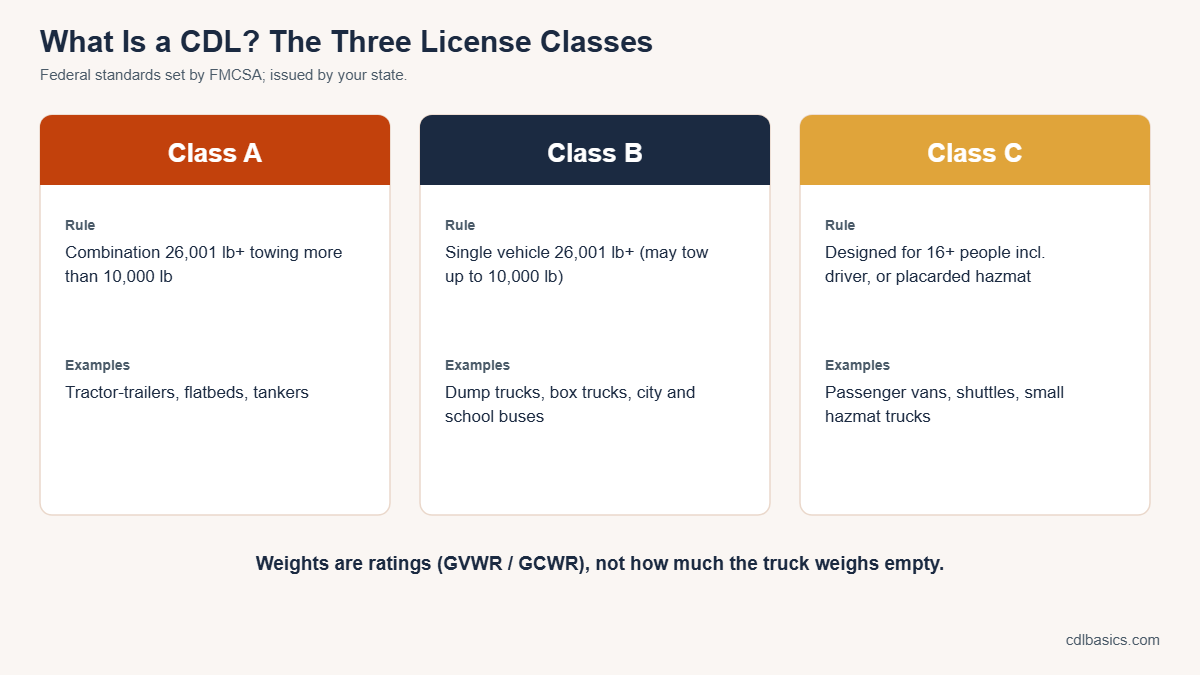
| Combination vehicle of 26,001 lb or more with a trailer over 10,000 lb | Class A |
| Single vehicle of 26,001 lb or more (or towing up to 10,000 lb) | Class B |
| Smaller vehicle designed for 16+ passengers including the driver, or carrying placarded hazmat | Class C CDL |
The weight is based on the vehicle’s gross vehicle weight rating (GVWR) or gross combination weight rating (GCWR), not on how much it weighs empty.
The Three CDL Classes
- Class A: tractor-trailers, truck and trailer combinations, many tankers and flatbeds.
- Class B: heavy straight trucks such as dump trucks, box trucks and cement mixers, plus large city and school buses.
- Class C: passenger vans and small buses for 16+ people, or smaller vehicles hauling placarded hazardous materials.
For a side-by-side look, see types of CDL licenses and Class A vs Class B.
CDL vs a Regular Driver’s License
| Regular license | CDL | |
|---|---|---|
| Vehicles | Cars, pickups, small vans and most RVs | Heavy trucks, combinations, large buses, placarded hazmat |
| Medical exam | Not required | DOT physical for most drivers |
| Training | Varies by state | ELDT required for first-time Class A/B and some endorsements |
| Blood alcohol limit while driving a CMV | 0.08% in a personal vehicle | 0.04% |
| Penalties | State traffic rules | Federal disqualification rules on top of state penalties |
| Drug and alcohol testing | No | Yes, for safety-sensitive jobs |
Should You Get a Class A or Class B?
If you’re not sure, many drivers choose a Class A because it lets you drive most Class B and C vehicles too, as long as you have the right endorsements. A Class B makes sense if you know you want to drive dump trucks, buses, box trucks or concrete mixers and want to start working sooner, since training is often shorter and cheaper. Your choice also depends on the jobs available near you; local construction and transit jobs often hire Class B drivers, while long-haul freight usually needs Class A. Compare both in Class A vs Class B CDL.
Endorsements
Some jobs need extra endorsements on top of the license class:
| Code | Endorsement | Tests |
|---|---|---|
| H | Hazardous materials | Knowledge, plus a TSA security threat assessment |
| N | Tank vehicle | Knowledge |
| P | Passenger | Knowledge and skills |
| S | School bus | Knowledge and skills |
| T | Double/triple trailers | Knowledge |
| X | Tank vehicle and hazmat combined | Knowledge |
How to Get a CDL: The Short Version
- Meet the age requirement and hold a regular driver’s license.
- Pass a DOT physical and get a medical certificate.
- Pass the knowledge tests to get a commercial learner’s permit.
- Complete Entry-Level Driver Training (ELDT) with a registered provider if you’re getting a Class A or B for the first time.
- Hold the permit at least 14 days, then pass the skills test.
Timelines and costs are covered in how long it takes and how much it costs.
CDL Restrictions
Restrictions limit what you can drive, usually because of how you took your skills test. Common restriction codes include:
| Code | Restriction | Usual reason |
|---|---|---|
| E | No manual transmission | Skills test taken in an automatic |
| L | No vehicles with full air brakes | Didn’t pass the air brakes test or tested without air brakes |
| Z | No full air brakes (air over hydraulic only) | Tested in a vehicle with air-over-hydraulic brakes |
| O | No tractor-trailers (fifth wheel) | Class A skills test taken in a non-tractor-trailer combination |
| M / N | Limits passenger or school bus class | Bus tested in a smaller class |
| K | Intrastate only | Driver under 21 or medical waiver |
Many restrictions can be removed later by retesting in the right vehicle. Ask your state licensing agency how.
How Old Do You Have to Be?
Federal rules let states issue CDLs at 18 for driving within one state (intrastate). To drive across state lines (interstate) or haul hazardous materials, you generally must be at least 21. Some states set their own higher minimums for certain endorsements. See how old do you have to be to get a CDL.
Entry-Level Driver Training (ELDT)
Since February 7, 2022, first-time applicants for a Class A or Class B CDL, and drivers adding a passenger, school bus or hazmat endorsement for the first time, must complete Entry-Level Driver Training from a provider listed on FMCSA’s Training Provider Registry before taking the relevant test. ELDT includes theory instruction and behind-the-wheel training. See can you get a CDL without going to school and how long is CDL school.
Medical Requirements
Interstate CDL drivers must pass a DOT physical from a certified medical examiner listed on FMCSA’s National Registry. A medical certificate is valid for up to 24 months, or less if the examiner wants to monitor a condition such as high blood pressure. You must keep your state licensing agency updated with your current medical certificate or risk a downgrade of your CDL. See CDL physical and DOT medical card.
Drug and Alcohol Testing and the Clearinghouse
CDL drivers in safety-sensitive jobs are subject to DOT drug and alcohol testing, including pre-employment, random and post-accident tests. FMCSA’s Drug and Alcohol Clearinghouse, in operation since January 2020, records drug and alcohol program violations. Employers must check it before hiring a CDL driver and at least once a year after that, and drivers with violations must complete a return-to-duty process before driving again.
How You Can Lose a CDL
Federal rules in 49 CFR 383.51 list offenses that disqualify a driver from operating a commercial vehicle. Examples include:
- Major offenses: driving under the influence, refusing an alcohol test, leaving the scene of an accident or using a vehicle in a felony. A first major offense generally means at least a one-year disqualification, three years if transporting hazmat, and a second can mean a lifetime disqualification.
- Serious traffic violations: such as excessive speeding or reckless driving. Two or three within three years lead to 60- or 120-day disqualifications.
- Railroad crossing and out-of-service order violations, which carry their own penalties.
The blood alcohol limit for drivers of commercial motor vehicles is 0.04%, half the typical limit for other drivers. Some of these rules also apply to offenses committed in a personal vehicle.
Hours-of-Service Rules
Holding a CDL also means following FMCSA’s hours-of-service rules if you drive interstate. For property-carrying drivers, the core limits include a maximum of 11 hours of driving after 10 consecutive hours off duty, no driving beyond the 14th hour after coming on duty, and a 30-minute break after 8 cumulative hours of driving. Passenger carriers follow somewhat different limits. Most drivers record their hours with electronic logging devices.
What Can You Do With a CDL?
A CDL opens jobs such as long-haul and regional trucking, local delivery, construction and dump truck driving, tanker and hazmat hauling, city transit and charter buses, and school bus driving. Many employers and community colleges offer paid or subsidized training. See free CDL training and is it hard to get a CDL.
Common Mistakes New CDL Applicants Make
- Skipping the ELDT check. Paying a school that isn’t on FMCSA’s Training Provider Registry can mean your training doesn’t count.
- Testing in the wrong vehicle. Taking the skills test in an automatic or a vehicle without full air brakes adds restrictions you may need to remove later.
- Letting the medical certificate lapse. States can downgrade a CDL when the medical card on file expires.
- Ignoring the permit timeline. A commercial learner’s permit must be held at least 14 days before the skills test and expires if you wait too long.
- Choosing a class without looking at local jobs. Check which class and endorsements employers near you actually want before you train.
- Overlooking training contracts. Some company-paid programs require you to work for the company for a set time or repay the cost.
What a CDL Does Not Cover
Most pickup trucks, RVs used for personal travel and rental moving trucks under 26,001 lb don’t require a CDL. Farmers, firefighters, military drivers and RV owners may also be exempt under federal or state rules. Check with your state’s licensing agency if you’re unsure.
Frequently Asked Questions
Is a CDL a separate card from my driver’s license?
No. A CDL replaces your regular license; you can only hold one license at a time.
Can I use my CDL in every state?
Yes. A CDL issued by your home state is valid nationwide, though drivers under 21 are generally limited to intrastate driving.
How long is a CDL valid?
Renewal periods are set by each state, commonly every four to eight years. Your medical certificate must be renewed separately, usually at least every 24 months.
Can I get a CDL with a criminal record?
A record doesn’t automatically block a CDL, but some offenses can disqualify you, and hazmat endorsements require a TSA background check. Employers also run their own checks.
Can I get a CDL if I wear glasses or take medication?
Often yes. Vision standards can be met with corrective lenses, and many medications are allowed. The certified medical examiner decides whether a condition or medication affects safe driving and may issue a shorter certificate.
Do I need a CDL to drive a box truck?
Only if its GVWR is 26,001 lb or more, or if it carries placarded hazmat. Many rental box trucks are under that limit.
The Bottom Line
A CDL is the commercial driver’s license required for heavy trucks, large buses and hazmat vehicles. There are three classes (A, B and C) plus endorsements for special cargo or passengers, and you earn one by passing medical, knowledge and skills requirements under federal rules. Once you have it, keeping it means staying medically certified, following hours-of-service and testing rules, and avoiding the offenses that can disqualify a commercial driver.
Explore CDL Basics
CDL Basics
- Class A vs Class B CDL: Key Differences
- What Is a Class B CDL and What Can You Drive?
- What Is a Class A CDL?
- Non-CDL Class C License Explained
- Types of CDL Licenses: Classes A, B and C
- Do You Need a CDL to Drive a Bus?
Getting Your CDL
- How Long Does It Take to Get a CDL?
- How Much Does It Cost to Get a CDL?
- Free CDL Training: How to Find It
- How Long Is CDL School?
- Can You Get a CDL Without Going to School?
- CDL Permit (CLP): Cost and Requirements
- How Old Do You Have to Be to Get a CDL?
- Is It Hard to Get a CDL?
CDL Tests
- CDL General Knowledge Test: What’s on It
- CDL Combination Vehicles Test Guide
- CDL Skills (Road) Test: What to Expect
- How Many Questions Are on the CDL Permit Test?
Endorsements & Medical
- CDL Hazmat Endorsement and Test Guide
- CDL Passenger (P) Endorsement Explained
- CDL Tanker (N) Endorsement Explained
- What Is the X Endorsement on a CDL?
- CDL Physical (DOT Medical Exam): What to Expect
- DOT Medical Card for CDL Drivers Explained
This article is for general informational purposes only. CDL rules, fees and testing procedures vary by state and can change; check with your state driver licensing agency and FMCSA before you apply.